Polaris (PII)·Q4 2025 Earnings Summary
Polaris Beats Revenue But Indian Motorcycle Charges Sink EPS; Stock Falls 7%
January 27, 2026 · by Fintool AI Agent
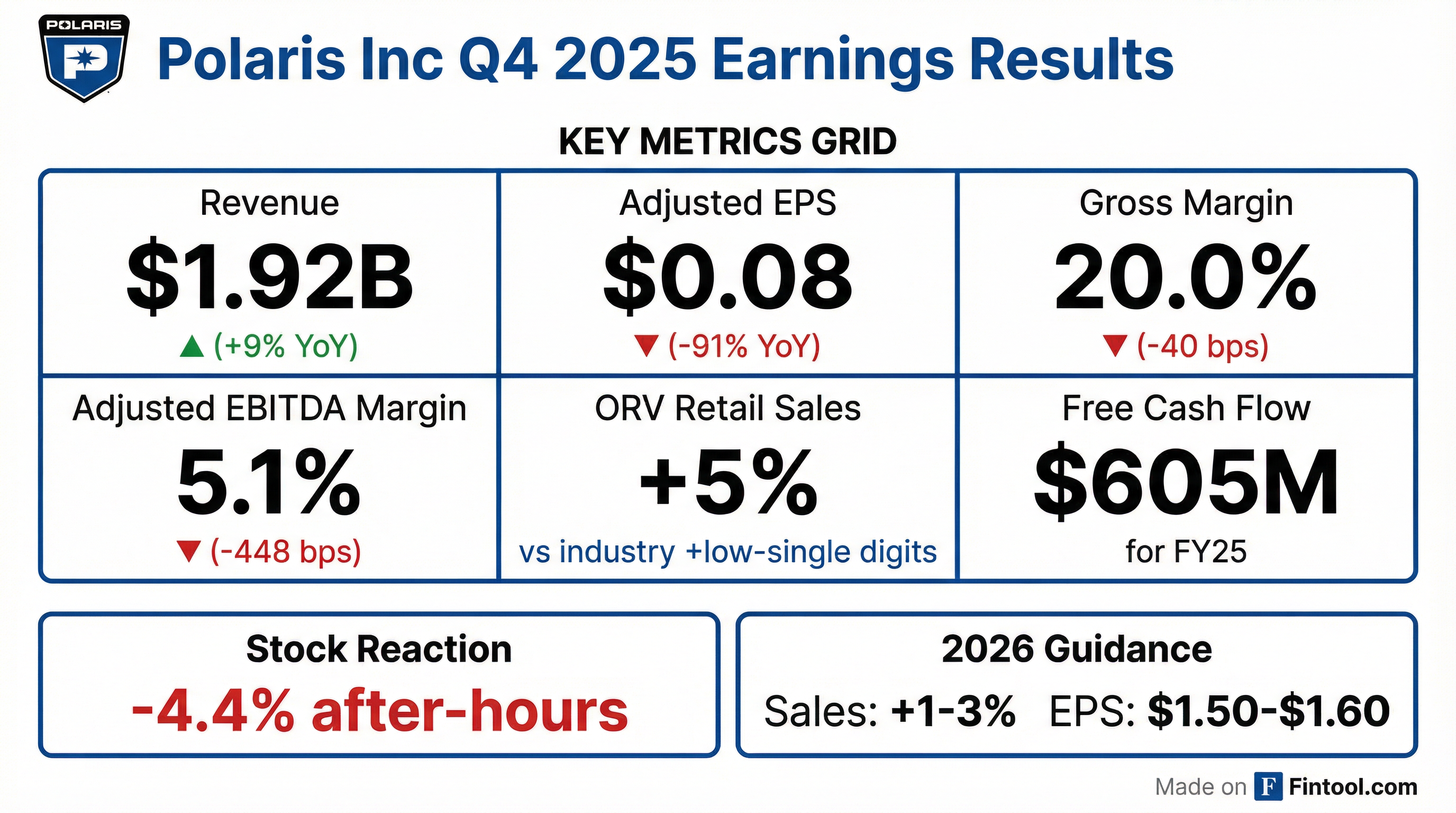
Polaris Inc. (NYSE: PII) delivered a mixed fourth quarter, posting solid top-line growth driven by its Off Road segment while facing significant headwinds from the strategic decision to exit Indian Motorcycle. Revenue rose 9% year-over-year to $1.92 billion, but adjusted EPS of $0.08 represented a 91% decline from Q4 2024 as margins compressed and impairment charges mounted.
The powersports leader gained market share across all segments for full-year 2025, yet shares fell 7% as investors digested the magnitude of charges related to the Indian Motorcycle disposal and Q1 2026 guidance calling for a -$0.45 EPS loss.
Did Polaris Beat Earnings?
Revenue: $1.92B reported (+9% YoY) — beat prior quarter expectations
Adjusted EPS: $0.08 (-91% YoY) — significant miss vs $0.92 in Q4 2024
The quarter's results were heavily impacted by one-time items:
The GAAP loss of $5.34 per share was driven by $288 million in impairment and charges related to Indian Motorcycle being classified as held for sale, plus an additional $54 million in non-cash impairment charges on Off Road segment intangible assets.
 Ask Fintool AI Agent
What Changed From Last Quarter?
Several key developments distinguish Q4 from the prior quarter:
Indian Motorcycle Strategic Exit: The company formally classified Indian Motorcycle as held for sale, triggering $288 million in impairment and transaction-related charges (majority non-cash). This represents a fundamental shift in Polaris's portfolio strategy, moving away from heavyweight motorcycles.
Tariff Headwinds Materialized: Tariffs drove $37 million of negative impact in Q4 alone, a primary driver of gross margin compression alongside lower net pricing and promotional activity. Management cited progress on mitigation: reduced China spend by over $100M in 2025 with plans to reduce COGS from China to under 5% by year-end 2027.
Retail Acceleration: Powersports retail sales excluding Youth products accelerated to +9% YoY in Q4, up from +9% in Q3 for ORV specifically. North America ORV retail (ex-Youth) outpaced the industry at +5% vs low-single-digits for the market.
Dealer Inventory Normalized: Management noted they achieved "healthy dealer inventory levels" heading into 2026, a key concern earlier in the year.
Segment Performance
Off Road — The Growth Engine
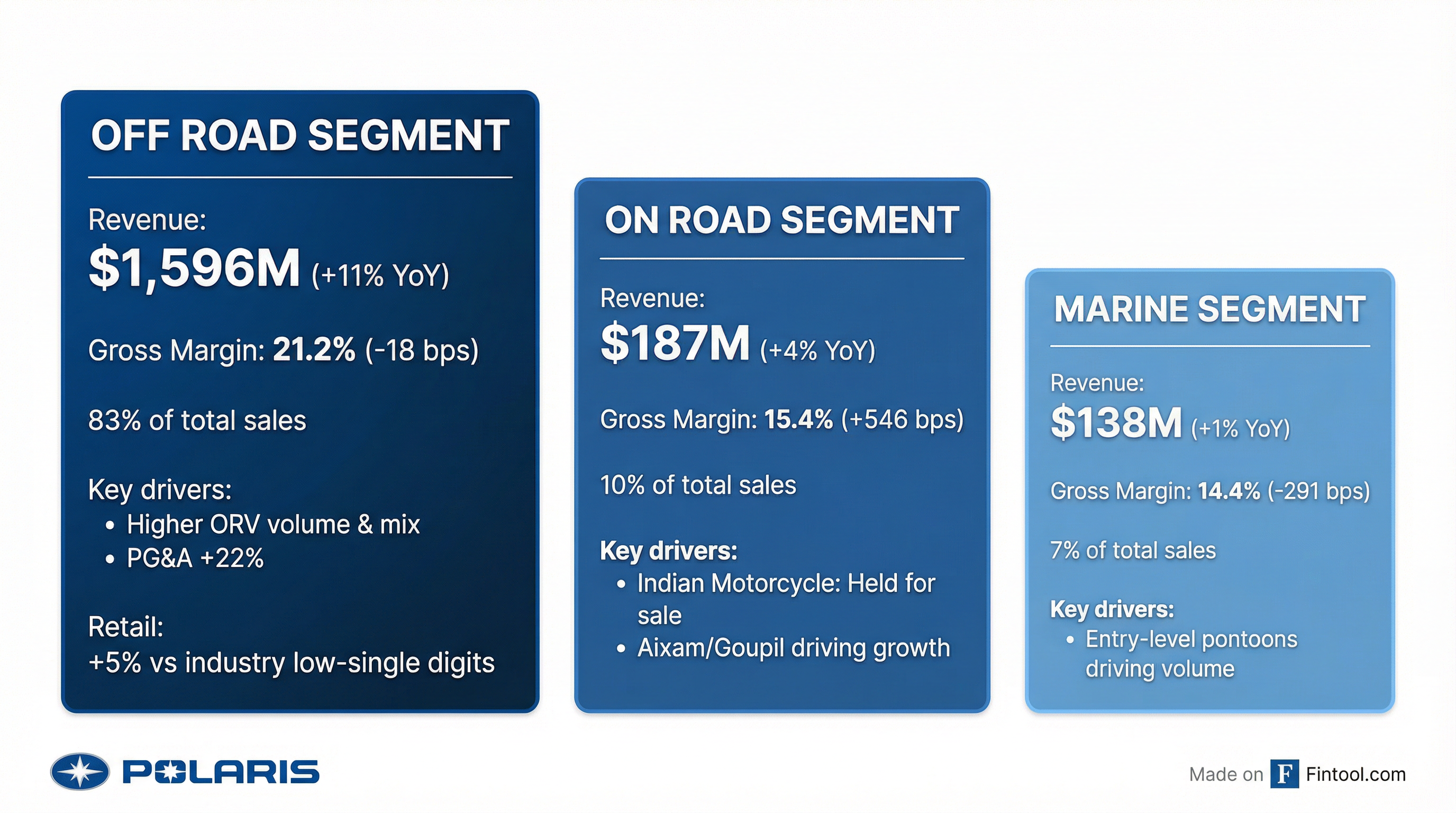
Off Road delivered $1.60 billion in revenue (+11% YoY), representing 83% of total sales.
Key drivers: Higher ORV shipments, favorable product mix, and strong PG&A (Parts, Garments & Accessories) performance. Gross margin was pressured by tariffs and promotions but largely offset by volume leverage and operational efficiencies.
Product Highlights:
- The new Ranger 500 was the highest-retailing midsize side-by-side in the industry during Q4, with roughly 60% more volume than the nearest competitor
- Ranger XP 1000 NorthStar achieved its highest retail month ever in December
- Polaris XPEDITION continues to take multiple points of share in crossover
- Polaris Factory Racing won the Dakar Rally podium for the third consecutive year
On Road — Transition Mode
On Road posted $187 million in revenue (+4% YoY) but the segment is in transition with Indian Motorcycle being divested.
Gross margin improved dramatically (+546 bps to 15.4%) driven by favorable mix from Aixam and Goupil (European light vehicles), though Indian Motorcycle retail sales continued to decline at a high-single-digit rate vs an industry that was up mid-single-digits.
Marine — Volume vs Mix Tradeoff
Marine grew modestly to $138 million (+1% YoY) with gross margin compressing 291 bps to 14.4%. The segment is seeing strong entry-level pontoon demand, which drives volume but at lower margins.
Ask Fintool AI AgentWhat Did Management Guide?
Polaris issued 2026 guidance that implies a significant earnings recovery:
Key 2026 assumptions: Flattish industry retail, meaningful tariff headwind of ~$90 million (larger y/y impact in first half), Indian Motorcycle separation expected to close by end of Q1'26, and continued progress on operational efficiencies.
Q1 2026 Specific Guidance: Sales expected to grow more than 10%, with tariffs representing a significant ~$45 million headwind. Adjusted EPS expected to be approximately -$0.45, as Q1 includes most of Indian Motorcycle's losses before separation.
2026 Free Cash Flow: Management expects approximately $160 million in operating cash flow and $120 million in free cash flow for 2026—a meaningful step down from the exceptional $605 million FCF in 2025, which benefited from one-time working capital improvements.
The EPS improvement implies the Indian Motorcycle separation will be accretive, removing a margin drag while allowing management to focus on the core Off Road and Marine businesses.
CEO Commentary
"2025 may have brought headwinds outside our control, but the Polaris team met the year with resolve, a disciplined focus, and unwavering commitment to our dealers and riders. We delivered strong results for the year, gaining share across our segments, enhancing operations, achieving healthy dealer inventory levels, and advancing strategies that strengthen our foundation."
— Mike Speetzen, CEO
"I've been with Polaris over 10 years, and I've never seen the organization more focused and energized than it is today. We're focused on the important elements to ensure we remain number one and to meaningfully improve profitability of our business model."
— Mike Speetzen, CEO
"That 40% incremental. I've worked in industrial companies pretty much my whole career, and that's not a number that happens easily. And I think when you look at our operations, we effectively have one Lean line at each factory... Our first-pass yield in terms of getting product through the line cleanly is still, it's much better than it has been historically, but we've still got significant improvements sitting in front of us."
— Mike Speetzen, CEO
Management emphasized that the long-term growth plan remains "anchored in category-defining innovation, efficient operations, and a best-in-class dealer network."
Q&A Highlights
Wholesale-Retail Alignment: $400M+ Tailwind
CFO Bob Mack noted that the revenue lift from aligning wholesale shipments with retail increased to over $400 million for 2026, up from approximately $300 million expected last quarter—driven by a stronger-than-anticipated Q4 retail performance.
When asked about flow-through on this volume benefit, management highlighted that excluding tariffs and $20 million in commodities headwind, the incremental margin would be closer to 40%—demonstrating the operational leverage built into the manufacturing network over the past two years.
"That 40% incremental—I've worked in industrial companies pretty much my whole career, and that's not a number that happens easily."
— Mike Speetzen, CEO
Marine: No Divestiture Planned
When asked about rumors regarding the marine business, CEO Speetzen was emphatic:
"We have zero intention of divesting the marine business. We know that many of our competitors tried to wade into the marine space and struggled. We have an excellent business, and it's an excellently run business... The business has returned over 80% of the original purchase price. Even at low points in the industry, the business is still making a lot of cash flow."
— Mike Speetzen, CEO
Slingshot: Interest-Rate Sensitive
Speetzen acknowledged that Slingshot, their three-wheeled roadster, "has been heavily impacted over the past couple of years" as their most interest-rate-sensitive product. The business has been losing money (though not material to consolidated results), and management has "an aggressive plan on how we're going to resolve that moving forward." A product refresh is planned over the next couple of years.
Industry Inventory Levels
When asked about industry-wide inventory, Speetzen noted that Polaris and its next-largest competitor together represent about 60% of the industry, and both are "pretty much in parity" on days sales inventory on hand and current-vs-non-current mix. Some Japanese competitors continue to struggle with elevated inventory, but their smaller market share (less than 10% each) limits the impact on dealers.
Utility vs Recreation Outlook
Management expects utility strength to offset ongoing pressure in recreation. CEO Speetzen noted that recreational consumers remain "somewhat on the sidelines" and likely need more relief from interest rates and continued inflation reduction before returning to the market. However, PG&A performance (wheels, tires, oil, parts) confirms people are still actively riding their vehicles.
When asked about potential benefits from the "One Big Beautiful Bill" (Bonus Depreciation, tax incentives for small businesses, farmers, ranchers), management said that's largely where utility segment benefits would come through. However, they have not assumed a significant uptick in recreational demand from higher tax returns, preferring to stay conservative until data supports it.
Retail Financing Conditions
On the lending side, CFO Mack noted credit statistics were "pretty consistent" through Q4 and full year 2025. Rates have come down slightly for consumers with 700+ credit scores, but nothing dramatic. Management is not planning for Fed help in 2026 and expects promotional financing to remain important for driving retail.
TSA Accounting Complexity
CFO Mack explained how the transition service agreements (TSAs) with Indian Motorcycle will impact 2026 financials: approximately $90 million will flow through COGS and $15-20 million through OPEX. Recovery comes through $60 million in sales, $10 million in COGS, and $35 million in other income. This creates about 30 bps of gross profit headwind in 2026, but the effect is neutral and will be clean by 2027.
2027 Indian Impact
Looking ahead to 2027, the Indian Motorcycle separation will provide an incremental $0.20-$0.25 in EPS benefit beyond the ~$0.75-$0.80 captured in 2026 (since the business won't be sold until late Q1 2026, some Q1 losses still hit Polaris's results).
Leverage Targets
CFO Mack expects leverage ratios to remain within covenant requirements through the challenging Q1-Q2 period (covenants in the 5x range), then get under normal 3.5x covenants by the back half of 2026. Long-term goal remains 1-2x leverage to maintain investment-grade rating.
Ask Fintool AI AgentHow Did the Stock React?
Polaris shares fell 7.1% following the report, as investors digested the magnitude of impairment charges and compressed margins.
Values retrieved from market data as of Jan 27, 2026
The negative reaction likely reflects:
- Magnitude of impairment charges on Indian Motorcycle ($288M)
- Significant adjusted EPS decline (-91% YoY) even excluding one-time items
- Margin compression from tariffs and promotions
- Conservative 2026 sales guidance (+1-3%)
- Q1 2026 expected to be a loss (-$0.45 EPS)
Key Risks and Concerns
Tariff Uncertainty: Management expects ~$90 million in tariff headwinds for 2026, with larger year-over-year impact in the first half. Total tariff load on the business is approximately $215 million (including legacy 301 tariffs), representing close to $3 of EPS drag. While mitigation efforts are underway (targeting <5% China COGS by 2027), relief from "policies of the current presidential administration and retaliatory actions" remains a key risk factor.
China Transition Progress: Polaris reduced China-based spend from ~18% of material COGS in 2024 to approximately 14% by year-end 2025, with a goal of below 5% by year-end 2027. This transformation is designed to lower tariff expense, minimize regulatory policy risk, and create a more localized supply chain with improved working capital and faster response times.
Operational Capacity: Monterrey and Huntsville plants operated at roughly 60% capacity in 2025. Management believes they can support substantial improvement in industry volumes with minimal fixed cost investment while maintaining quality standards—a source of operating leverage as the market normalizes.
Indian Motorcycle Execution: The proposed separation must be completed "in a successful and timely basis" with risks around deriving expected benefits within the timeline.
Consumer Spending: Economic conditions impacting consumer spending and credit availability remain a concern, including "recessionary conditions and changes in interest rates."
Class Action Litigation: Ongoing litigation expenses of ~$33 million expected in 2026.
Operational Improvements
Beyond financial results, Polaris made significant operational progress in 2025:
Management emphasized that quality has "meaningfully improved" with better clean build, lower rework, improved labor efficiency, and reduced inventory. Initial model year 2026 metrics have improved versus last year.
Full Year 2025 Summary
The standout for 2025 was free cash flow generation of $605 million, up dramatically from $65 million in 2024, driven by working capital improvements.
Balance Sheet Strengthening
Polaris made meaningful progress on its financial position in 2025:
Working capital efficiency improved dramatically—from 5% of sales in 2023 to -2% in 2025—driven by lean manufacturing, better alignment between demand and procurement, supply chain localization, and optimized payables management.
Ask Fintool AI Agent2026 Mix Headwinds
CFO Mack noted several expected mix headwinds for 2026:
- NorthStar normalization — Strong 2025 NorthStar shipments may not sustain at same levels
- Ranger 500 success — Selling well but at lower margins than premium models
- Marine recovery — Shipments aligning to retail improves volume but at structurally lower GPs
- Snow recovery — Snow gross margins are structurally lower than off-road
These headwinds are expected to be partially offset by a lower promotional environment (inventory is healthier) and normal model year price increases.
Forward Catalysts
- Indian Motorcycle Separation Completion (Q1'26) — Expected to be accretive once finalized, removing margin drag
- 2026 Margin Recovery — Guidance implies 80-120 bps EBITDA margin expansion
- Tariff Mitigation Progress — Targeting <5% China COGS by year-end 2027
- ORV Market Share Gains — Continued outperformance vs industry with under 100 days dealer inventory
- Operational Leverage — $240M+ structural savings realized over 2 years, set up for higher incremental margins in mid-cycle recovery